

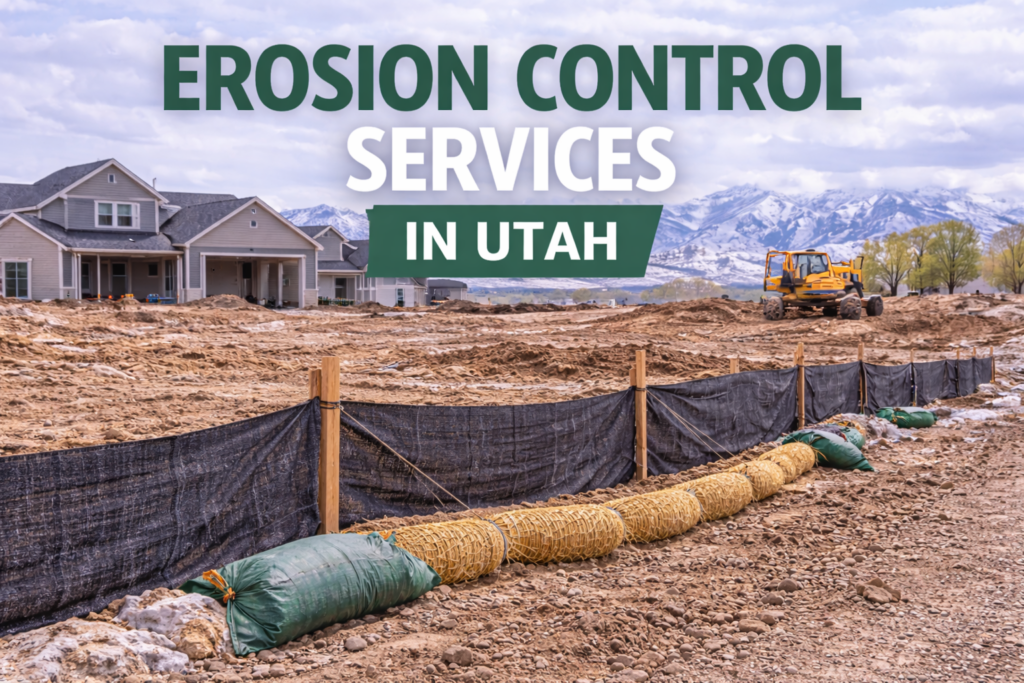

Managing a Utah construction site means dealing with erosion from day one. Not eventually — from the moment you break ground. Loose soil, graded slopes, and exposed fill are all moving the second it rains or the snowpack starts letting go in March.
Most contractors understand erosion control exists. Fewer understand how it actually works, which controls do what, and why a site that looks compliant can still fail an inspection. This guide breaks that down.
What Erosion Control Is Actually Doing
The goal isn’t to stop water from moving — that’s impossible on an active construction site. The goal is to slow it down, filter it, and prevent it from carrying your soil off the property and into the storm drain system.
Utah’s construction environment makes this harder than average. You’ve got:
- Spring snowmelt that dumps volume fast, often faster than frozen or compacted soil can absorb
- Summer monsoon patterns that hit the Wasatch Front with short, intense bursts
- Freeze-thaw cycles through fall and winter that loosen soil structure repeatedly
- Clay-heavy soils in much of Salt Lake and Utah County that seal up and sheet-flow rather than absorbing
A silt fence that works fine on a flat Texas site may be completely overwhelmed on a sloped Herriman subdivision lot after a late-April snowmelt. Erosion control has to be chosen and positioned for what your specific site actually does with water.
The BMPs You’ll Actually See on Utah Sites
BMP stands for Best Management Practice — the physical controls required under your SWPPP. Here’s what each one does and where it goes:
Silt fencing runs along the downhill perimeter of a disturbed area. It’s a permeable barrier that slows runoff and traps sediment. It works when it’s properly trenched in (not just staked) and when it’s maintained after storms. A silt fence that’s blown out, silted up, or undercut by vehicle crossings isn’t doing anything.
Straw wattles and fiber rolls go along slopes and drainage channels. They break up sheet flow, slow velocity, and give sediment somewhere to settle before it reaches the perimeter. On steeper Wasatch Front lots, spacing matters — too far apart and water gains enough speed to blow right through them.
Inlet protection is exactly what it sounds like: a device that goes over or around a storm drain inlet to catch sediment before it enters the system. This is one of the most inspected elements on Utah sites because a blocked inlet failing during a rain event is exactly the kind of violation that gets photographed and cited.
Sediment basins are for sites with significant drainage volume or concentrated flow paths. They’re a low point where runoff collects and settles before discharge. Required on larger sites and anywhere with long drainage runs.
Slope stabilization — erosion blankets, hydroseeding, turf reinforcement matting — is the long game. Vegetation is the only permanent erosion control. Everything else buys time until the slope is stabilized. Utah DEQ final stabilization requirements are tied to vegetative cover, not just BMP installation.
When BMPs Fail and Why
Most erosion control failures on Utah sites aren’t installation failures — they’re maintenance failures. The controls were put in correctly and then nobody looked at them again.
After a storm event, you’re required to inspect within 24 to 48 hours. What you’re looking for:
- Silt fence that’s been undercut, torn, or blown over
- Wattles that have shifted or been run over by equipment
- Inlet protection that’s full and no longer filtering
- Any concentrated flow path that’s developed since the last inspection
The freeze-thaw issue is specific to Utah winters. A silt fence post that’s solid in November may be completely heaved out of the ground by February. Winter inspection rounds get skipped more than they should, which is exactly when the issue builds up quietly and shows up as a compliance problem in the March thaw.
How Erosion Control Connects to Your SWPPP
Your SWPPP isn’t a document you file and forget. It’s a living record that has to match what’s physically on your site. Every BMP installed needs to be reflected in the plan. Every inspection — weekly and post-storm — needs to be documented.
When a DEQ inspector shows up, they’re cross-referencing what they see on the ground against what your SWPPP says is there. Discrepancies are violations. A missing BMP that was supposed to be installed per the plan is a violation even if the site physically looks fine.
This is one of the more common traps on Utah sites: contractors who are physically doing the right things but aren’t documenting them correctly. The compliance problem isn’t the erosion control — it’s the paperwork.
What This Means for Your Project
Erosion control on a Utah construction site isn’t a one-time installation. It’s an ongoing management task that runs from the day you grade through the day you hit final stabilization and file your Notice of Termination.
If you’re running it yourself, that means weekly site walks, post-storm inspections documented in your SWPPP, BMP repairs or replacements as needed, and seasonal adjustments for what Utah weather actually does.
If you’d rather have someone else manage it, Lavanta handles professional erosion control services across Utah — installation, inspection documentation, BMP maintenance, and SWPPP alignment. Most contractors find that having one team handle both the plan and the physical controls is simpler than coordinating two.
Either way, get it in place before you start grading. The violations that are hardest to fix are the ones that started on day one.
How is erosion control different from my SWPPP?
Your SWPPP is the written plan — it identifies the risks and specifies which controls to install. Erosion control is the physical execution of that plan. One doesn’t work without the other.
What do erosion control services include?
They include silt fencing, wattles, inlet protection, slope stabilization, and sediment control measures.
Do I need erosion control on small Utah projects?
Utah DEQ requires a Construction General Permit and erosion controls on any project disturbing over one acre. Smaller projects may still fall under local municipal requirements — check with your city or county before assuming you’re exempt.
Do erosion control services help with SWPPP compliance?
Yes, they are a core part of any SWPPP plan and without them, you don’t have a complete SWPPP in place.
How often do BMPs need to be inspected?
Weekly during active construction, plus within 24 to 48 hours after any qualifying storm event. Both need to be logged in your SWPPP.
What’s final stabilization in Utah?
The point at which all disturbed areas have uniform vegetative cover of at least 70%, or equivalent non-vegetative cover. Once you hit final stabilization and all construction is complete, you can file your Notice of Termination and close the permit.